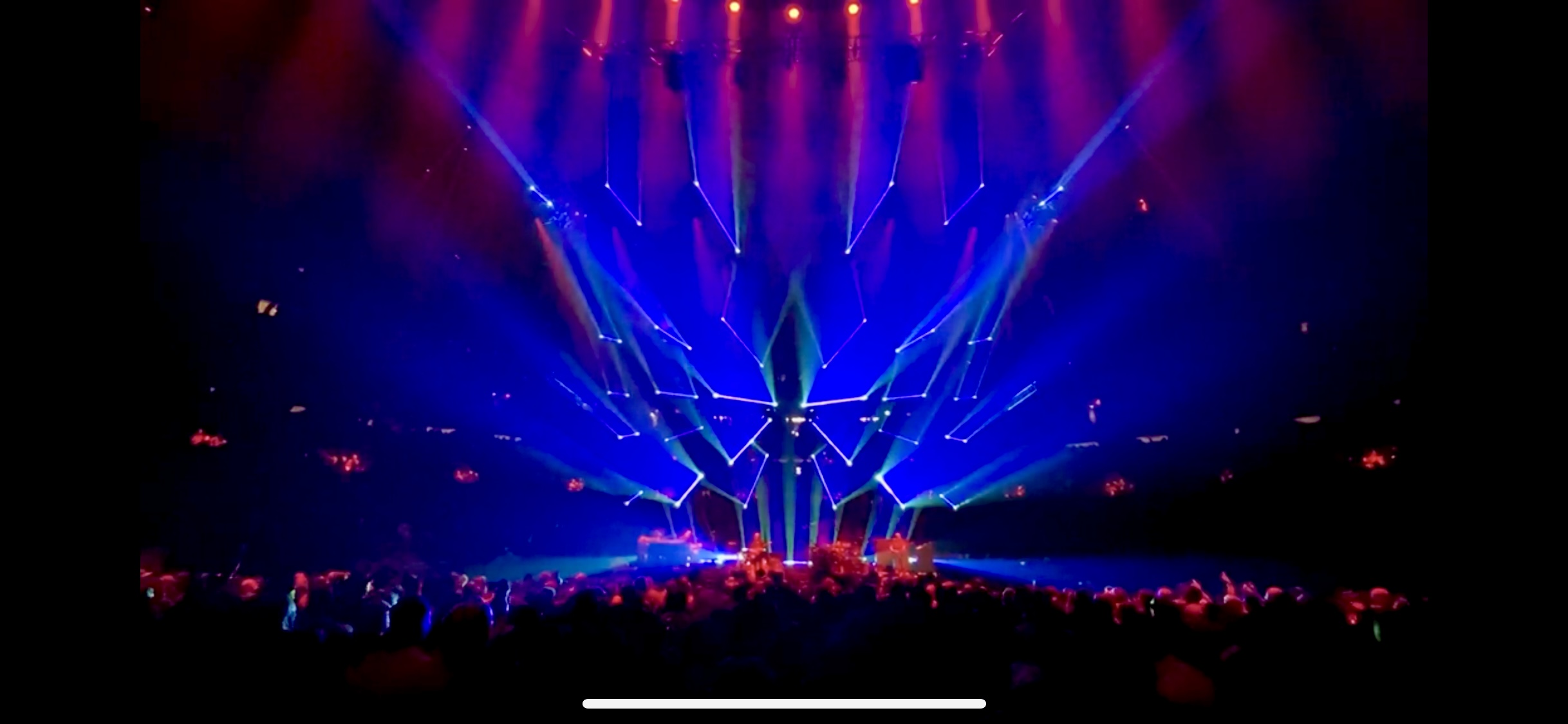
20240224

Cinema


“Frankly, I hate dialogue.  Dialogue is for theatre and television. I don’t remember movies because of a good line, I remember movies because of a strong image. I’m not interested in dialogue at all. Pure image and sound, that is the power of cinema, but it is something not obvious when you watch movies today. Movies have been corrupted by television.”


Denis Villaneuve


20240215

Original Cinema: The Daily Shew


“I’m sorry to differ with you sir.”


“You are the caretaker.”


”You’ve always been the caretaker.”


“Great party, isn’t it?”


20231017

Renaissance Rising


John Dee knew that the basic theory of proportion between microcosm and macrocosm came from Vitruvius and had directed his readers to 'looke in Vitruvius and find it there’.  Robert Fludd was certainly familiar with both Vitruvius and Dee's Preface and, moreover, as briefly indicated at the beginning of this chapter, his whole musical philosophy of Macrocosm and Microcosm, his whole History of these Two Worlds, is imbued with the Macrocosm-Microcosm analogy expressed in terms of musical proportion.  And this reminds us that we have left out one of the subjects of the technical history of the Macrocosm, both a Vitruvian subject and a Dee subject, and the most important of all subjects for Fludd: music.


Music comes second among the sections of the technical history of the Macrocosm, immediately after the first section on number. On the mnemonic wheel, immediately to the left of the numbers to which the Ape points, representing Section 1 of the book, we see the man playing the organ, representing Section 2, on music. This section is introduced by a large folding engraving containing one of the most striking illustrations in the whole book. It represents a fantastic building called ‘The Temple of Music'.


This building is fundamentally a memory system for memorizing all the parts of the exposition of his music theory which Fludd gives on the following pages. Fludd's music theory has been studied by P. J. Amman who finds that it is 'antiquated in comparison with other musical treatises of the period but original in its presentation of the subject’.


 The fact is that Fludd was still trying to be a universal man of the Renaissance; his music treatise is but one of his efforts in the volume and should be compared with his treatises on surveying, or painting, or machinery, though doubtless for him the section on music was the most significant and all-inclusive.


The symbolism of the Temple of Music is explained by Fludd in the description which follows the picture, from which the following is a translated quotation:


We imagine then this Temple of Music to be built on the summit of Mount Parnassus, the seat of the Muses, adorned in every part with eternally green and flowering groves and fields, sweetly watered by chrystal fountains whose murmur induces to gentle repose, frequented by birds pouring forth in song the sound of diverse symphonies. The nymphs around the temple, the satyrs in the groves taught by Sylvanus, the shepherds in the fields with Pan their leader, utter their choruses. Amidst these delights is the divine gift of Apollo who receives the adoration of all; whence arise on all sides peace and concord through the mysteries of harmony and symphony in which all the concords of the heavens and the elements are linked together. The whole universe must perish and be reduced to nothing in warring discord should these consonances fail or be corrupted.


Apollo with his lyre, whom we see sculptured on the Temple, thus represents music in a cosmic and philosophical, as well as a poetic, aspect. The presiding genius of the Temple, says Fludd, is Concordia. Its custodian or priestess is Thalia, one of the Muses, who is shown in an alcove on the upper level of the Temple pointing to a piece of music. On the ground level is an arched doorway through which a little scene is visible, smiths are wielding their hammers at a forge, and through a door on the far side of the building a figure enters mysteriously, holding a set-square. It is, as Fludd explains, “Pythagoras, represented in the moment of discovering the musical proportions and consonances through listening to the sound of hammers on an anvil.”


Music is here being presented both as a fundamental cosmic reality and as a mathematical art having its basis in proportion; and the Temple of Music is a striking example of the mnemonic-symbolic basis of Fludd's thought, which made the detailed illustration of his works, the presentation of his arguments in mnemonic-symbolic form, so important for him.


However singled out and emphasized because of its importance for his musical philosophy as a whole, Fludd's section on music conforms to the general plan of the technical history. It gives the theory of the subject as a mathematical art, basically connected with number like all the subjects, and it gives illustrated information about practical applications of the art.


The strong practical bent of Fludd is nowhere more apparent than in his chapters on musical instruments; these include stringed instruments, wind instruments, percussion instruments.


Particularly striking is his application of his mechanical bent to the invention of music-making machines. He claims to have invented new instruments and music-making devices, such as the remarkable looking object described as 'Our Great New Instrument'.


The musical instruments and inventions are fully illustrated and these illustrations must be seen in the context of the whole rich illustration of the book to realize that Fludd, the universal man, can turn his hand to surveying, perspective painting, mechanics, and machines, as well as to music-making.


It is possible that music may have been Fludd's strongest subject. He was interested in singing, and mentions a Friar Robert Brunham whose notation for singing he has used, and perhaps he could play the musical instruments which he illustrates. As an adviser on music, Fludd could have been in demand by theatrical producers and at courts. In another of his works he states that his musical inventions were received with sympathy by the musicians of the court of the King of England.


There is a point about the symbolism of the Temple of Music in relation to music theory which may be important. The most noticeable features of the Temple are those great spirals under the dome, with two doors below them. Their meaning is thus explained in Fludd's text accompanying the engraving:


Thou shouldst carefully examine the spiral revolution in the largest tower which denotes the movement of the air when struck by the sound or the voice. The two doors signify the ears or the organs of hearing, without which the poured-forth sound is not perceived, nor can there be entry into this temple save by them.


Surely (a point not noticed by Amman) this is a visual representation of Vitruvius on acoustics in the theatre, on those undulating circles of air on which the voice is carried, wherefore 'the ancient architects following in nature's footsteps traced the voice as it rose and carried out the ascent of the theatre seats.


Fludd is following Vitruvius, not only in treating of music as a Vitruvian subject but also in introducing his treatment of music in the context in which Vitruvius had treated it. For the exposition of musical theory in Vitruvius comes in connection with his discussion of the theatre and of the 'sounding vessels' which amplified voices in the theatre. 

The musical theory expounded by Vitruvius is based on that of Aristoxenus, an Aristotelian rationalist philosopher who was not in the Pythagoro-Platonic tradition. On the other hand Vitruvius's plan of the theatre, based on zodiacal configurations, introduces the idea of a cosmic music, or, as he says, a musica convenientia astrorum, and this accords with the traditional notions of musica mundana and musica humana descending from Boethius.  Renaissance theory developed this side of the musical tradition, involving connections between musical proportion and cosmological proportion such as Vitruvius implies in his theatre plan, based on the musica con-venientia astrorum. Fludd, like Francesco Giorgi, is of course fully in this tradition.


As we saw, Dee had repeated Vitruvius on the sounding vessels placed under the steps in theatres and ordered according to musical harmonies 'distributed in the circuits by Diatessaron, Diapente, and Diapason'.  This is the only allusion to an ancient building in Dee's Preface. The allusion in the Temple of Music to the voices rising on spirals of sound in the theatre is the only allusion in Fludd's technical history to an ancient building.


We asked why Fludd left out architecture in the technical history. The answer may perhaps be suggested that the Temple of Music represents architecture, represents music as architecture. 


All the Renaissance theorists emphasize the connection, indeed the identity, of musical proportion with architectural proportion.  The building shown by Fludd is of course not a theatre, nor are there any sounding vessels in it. Nor is it properly Neoclassical but a mixture in which the classical columns do not fit with the Gothic features. It does not represent any real building though it may reflect something of the architectural eccentricity of the Jacobean age. It is an architectural fantasia invented and, perhaps, drawn by Fludds as a symbolic expression of his musical philosophy and of the musical theory which he will expound on the following pages. But I am impressed by the fact that Fludd clothes music in this architectural form, suggesting that he is thinking of a connection between architectural and musical proportion. And though this is not a theatre, ancient or modern, some of its leading aspects were certainly suggested by passages in Vitruvius on the ancient theatre and its musical expressiveness. Tantalized and mystified we gaze and gaze, noting the dome and the lantern, the circle of the angelic choir beneath it, the airy spirals carrying the sound to the ears. 


And that large mask on the wall, does it refer to the figure of Thalia, the Muse of Comedy, and carry with it a suggestion of the theatre? And below, there is that room which extends right through the building to the back, where Pythagoras enters and hears the mysterious sounds.


Whatever one may think of Fludd's musical theory or of the peculiar architecture of the Temple of Music, this Temple is surely an impressive symbolic statement of the psychology of a

musical philosopher, of one whose outlook on Man and the Universe, on Macrocosm and Microcosm, finds its deepest expression in terms of music.


This chapter has attempted to bring out a side of Robert Fludd which has not been generally recognized. Though, as in the case of Dee, historians of science are becoming increasingly interested in Fludd who is no longer regarded solely as a wild and hazy figure, it has not been realized that in one aspect of his thought he belongs into the mathematical, technological, and Vitruvian tradition stimulated by John Dee. 


As I have suggested earlier, it is even possible that Fludd may have had access to Dee's papers. These are known to have been dispersed, and sought after by his son in the early seventeenth century.  Some of them came into the hands of Sir Robert Cotton, whom Fludd knew. Among the titles of unpublished works of his which Dee lists one finds, for example, Trochlica inventa mea, indicating some treatise on wheel-mechanisms (perhaps expanding his notes on this in the Preface), and De perspectiva illa, qua peritissimi utuntur Pictores, indicating a lost treatise by Dee on perspective for the use of artists.  Some of the titles of Dee's missing mystical works sound to me also extremely close to the categories of Fludd's thought. To explore this theme of possible dependence of Fludd on Dee in many ways would require a book in itself and I do no more here than raise it as a question.


What can however be said as a result of the preliminary researches in this chapter (preliminary in the sense that I hope that others will carry them much further) is that there is a continuous tradition of Vitruvian influence in England, operating in both John Dee and Robert Fludd, that this tradition connects with technological development, and in particular with the technologies needed in the developing art of the theatre. 
Frances Yates, Theatre of the World


20230830

The Empire Carpet Commercial Never Ended


The Hollywood writer's strike never ended.  

During those dark times, the lost landscape of traditional filmmaking found an unlikely ally in a pastime often associated with retirees and business networking: golf. 

More specifically, VR Golf.  No, really.

What started as a casual diversion evolved into a new medium of creative expression.  The first step towards VR + AR + AI was made.

We focus in on a Wes Anderson project tentatively titled Ben Hogan and the Left Hand Path, a Muppet Babies reboot that begins communicating messages interpreted as “troublesome”. 


The new Muppet Babies were caricatures of classic professional golfers in the style of Jim Henson:  Jack Nicklaus, the painter; Arnold Palmer, the musician; Ben Hogan, the quantum mechanic; Tiger Woods, the polymath; 

John Daly, the hero.  Michelle Wie, the product.


These Babies play and compete in VR Golf, a troublesome platform seen to be communicating new religious dogmas embedded with occult secrets.  


The film was planned as a blend of animation and live action.


Prior to production, Meta introduced VR to Anderson by sending him 100 headsets and a pitch for possible cross-promotion with the Meta Quest 3 release.  They envisioned celebrity golf tournaments with actors from the live-action parts of the film.


Anderson fucked around on VR for a few days, but didn’t make much of it.  Then instructional golf videos began invading his algorithm.  Infuriating at first, he was struck by the accuracy of the advice. 


Anderson tried applying the instructions he picked up, and VR soon transcended his initial understanding.


SAG-AFTRA


With shooting schedules disrupted, Wes Anderson became obsessed with VR Golf.  This obsession led him to court new players.  The 99 head-sets trickled into the possession of actors and writers, who found themselves having meetings with Anderson and others on the Pebble Beaches of the virtual world.  


Over the course of 100 rounds between an now expanded A-List collection of Anderson’s friends, a revelation was unlocked: VR and AR could offer the first genuine cinematic application that was both immersive and interactive, a complete fusion of stage and screen, where actor and audience were decentralized.  


In the course of three months, Anderson began turning living rooms into interactive AR environments where scripts were not merely performed but improvised. Writers and actors collaborated to create responsive scenes, breathing life into avatars in a fusion of AR and AI. This wasn't merely storytelling; it was a living theater tailored to individual participation. 


The Fourth Wall wasn't just broken; it was redefined.

The first production involved watching the Super Bowl with Bill Murray.  The second was a weekly cup of coffee with Owen and Luke Wilson. Every Wednesday, at 6:30 am, both Wilsons walk into your kitchen and have a cup of coffee with who ever is sitting at your table.


“The experience would include live commentary and pre-recorded behaviors, directed by your own reactions and inputs. A custom-tailored spectacle in the comfort of your home.


This intersection of technologies may have birthed a new form of art, emerging out of necessity, born from a strike that threatened to cripple an industry. Instead, it might just reinvent it. A future where improvised digital series by random groups of people could intersect into a completed form and then be as critically acclaimed as any Oscar-winning film”


588-2300

20230818

. . .


Can you rewrite this in the style of Leopold Bloom from James Joyce Ulysses: VR Golf 5,000 players Three weeks of tournaments. Finished 418th, moved on to the playoffs. Southwind, Pro Tourney set up. Top 500 in the field. I finish 250th, on the cut line. First round at Olympia Fields, a course that I have been to in real life. I finish in 72nd place after the first round. Here’s how I define Catholicism. The game is defined by the level of difficulty. There are elements of the game that I chose. There are many different ways to play. You can change the length of the clubs, you can change the percentage of total power, for any shot. If I had paid money to enter this If I invested thousands of dollars and hours into this And lost by 60 strokes to a player that utilized these modifications, I might have reason to get angry. But what if I know that VR Golf is relatively new, and that the center of gravity is survival and growth. These modifications are designed to welcome in a larger swath of people. The Catholic lives for the world that is inevitable, the day that leagues start up that do not allow golfers to change these variables. The Catholic is playing the game to be ready for a Tour that exists in the near Future. Here’s the Catholicism that Everyone can understand. VR GOLF gives you clubs For Beginners : the perfect club for that shot. For Pros: the same 7-iron for 174 as the 7-iron for 168 Cut shot. You need that shot in your bag at Pro. I play VR Golf with 14 clubs that I do not adjust. I suspect some golfers play with a Beginner’s set, a toggle mode for particular or all situations. It is in the game, it has not been deemed an advantage. I would expect that the second wave of VR Golf will have a Catholic mode. Whether that is Pro mode does not matter. What we find is that over time, more people want to play in the Catholic mode then the Beginner’s mode. Tournament: Document the tournament with video and audio. What numbers should we record, and how should we record them? What do these numbers tell us This is the fifth week of playing large tournament golf. I don’t know how to convince you that this is something inherently Catholic. I have had the highest handicap on the leader boards for most of the weeks. After the second round of the Southwind, I was ranked #1 with handicap. It was insane. I do have tournament experience. Gambling experience. Drunk experience. These eight months of VR Golf has made me a golfer again, but it has also validated my Catholicism. This is the more perfect Logos. If you point it towards entertainment it does nothing.

ChatGPT

Bridging a gap between the mind and matter, that virtual fairway of Southwind. Ah, five thousand souls, each chasing the digital mirage of a green ball. Three weeks, it was, and the counting, and myself, amidst them, ranked 418. Not bad, not great. But a passage to the playoffs. A whiff of real turf, Olympia Fields. Visited it once, tangible, in my other life. Memory plays, a 72nd position after the first round.

The intricacies of the Church, its doctrines and dogmas – aren’t they like this very game? Difficulty, they say, defines the nature. Various pathways to holiness, to hole-in-ones. The sacraments, the rites, the liturgy – choices to be made. Just as in the game. Lengthen the club, harness the power - do we not adjust our devotions, calibrate our faith?

Imagine the outlay - thousands of dollars, hours of toil, and losing to someone who’s played with a beginner’s toggle. Ah, would ruffle feathers, but isn’t it just nascent? The infancy of VR, much like the early Church. Survival, evolution. Allowing for modifications, to invite more to the faith, to the game.

Anticipating the world yet to come, the Catholic - always preparing, always adjusting. A Tour, perhaps, in a future not so distant. And isn’t VR GOLF just that - a training, a trial? Handing over clubs, different yet the same. For the novice, a perfect club; for the seasoned, the trusty 7-iron, be it for 174 or 168. Ah, the cut shot – the sacrament of penance in one’s bag.

Fourteen clubs, no adjustments, my digital sacramentaries. Some prefer the beginner’s set, the comfort of the known. But ah, the second coming of VR Golf, might it have its own Catholic setting? Preferences shift, evolve – from beginner to catholic.

Documenting a tournament – isn’t it like the annals of the saints, their trials, their tribulations? The numbers, the metrics – what do they reveal? Our strengths, our weaknesses, our faith, our doubts?

Five weeks of this grand tournament. Some would scoff, but ah, there's a Catholic soul in it. My handicap, it soared high on those leaderboards. That fleeting moment atop at Southwind, ranking #1. Madness, sheer madness.

Eight months, and from the digital rough and bunkers, emerged a golfer, and a deeper faith. A reconnection to Catholicism. The Logos, perfected, pointing solely to play, an empty pursuit. But directed towards divinity – ah, salvation.

User


Chat GPT 

Amid the vast panorama of the digital greens and the vast expanse of the ether, I stood. Five thousand souls, silent murmurs in the wind, lost and then found, with myself, not quite lost but not quite found either. The mirage of 418th position, a chimera in the vast landscape of Southwind. Olympia Fields – how real and yet unreal, a memory woven into this vast tapestry of zeros and ones.

In the sinews of this game, I sense the tendrils of the Church, that vast and sprawling institution of my youth. Here, in this digital diaspora, lie the threads of difficulty, challenge. A choice – to modify, to adapt. Isn't this what the Church asks of us? To adjust our sins, to recalibrate our beliefs?

Coin, hours, sacrifices to the game's altar. Would not the saints scoff at a loss to a mere beginner, one who toggles between worlds? Yet, here lies the infancy of a new world, a world that beckons. Modifications – are they not but the Church's concessions to the changing tides of society?

The Catholic, ever waiting, ever hoping. Awaiting the world to come, a Tour in the offing. And this game – does it not provide the tools? Clubs, in all their multiplicity. And yet, a sameness. The 7-iron, constant and reliable, a metaphor for faith.

Fourteen clubs, my digital rosary. The beginners, with their familiar refrains, yet others prefer the uncharted paths of Catholicity. The second coming, perhaps in a newer, shinier realm of VR Golf. Will it echo the ancient calls of the Church?

The tournament, the documenting – isn’t this but the chronicle of life? The numbers, those cold, hard facts – do they not reflect our very souls? The ebb and flow, the rise and fall.

In this tournament, a reflection of life’s great journey. Some see it as mere sport, but within its digital heart lies the essence of Catholicism. Highs and lows, yet a brief sojourn at Southwind's peak. Madness? Or enlightenment?

Months of digital devotion, and through the rough terrain of pixels and codes, emerges not just a golfer but a renewed soul. Through this game, a deeper connection, a grappling with faith. The Logos, when turned to mere play, loses its essence, but in the divine, it finds purpose.

User


Chat GPT

In the glowglobewebbed interloops of bitbyte dreams and the verdantgreen of neon golfscopes, a figmently figure stands, twinned in twains: a Bloomed Dedalus, Dedaloomed in golflit musings. Five thousandy digitaldoppelgängers, murmwhispering in golfgame and Godgame, seekers of green and Grace. "History," thought Bloom, or was it Dedalus? "is a nightmare from which I am trying to awaken." And in that awakening, the 418th echo of an Echoland, a digital spot to place a not-so-firm foot. Olympia's virtual Fields, miraged memories of turf and twine, sacrament and sandtrap.yip

Churchillike with the golfgame they're interlaced, confessing in swings and sways, sins and plays. “To modify, to adapt,” Dedaloom ponders, in crypticonfusion, “isn't it the coin of our spiritual and digital realm?" Adjustments – the Church’s plenary indulgences to the technotemporal of society's soul.

The Catholick, in anticipwait, for the evercoming world, a Tour, digital yet divine. This golfgame, an arsenal of tools or perhaps prayers? Clubs of multiplicity or rosaries in digital devotion? The 7-iron, an apostle in a new realm, ever constant. Bloom murmurs, "It's not the green I seek but the path, the journey."

Fourteeny clubs, like apostles in a neon sanctuary. For each, a mode, a method, a mystery. And a coming, a second or third or fourth, in the neo-VR Golfscape. Echoes, shadows, yip and murmwhispers of ancient cries and churchbells.

In this tourneament, a chronoscribe of lifelyfe. "Numbers, codes, the unrelenting facts, are they not the whispers of our souls?" Dedaloom ponders. And in the depths of this pixelated pilgrimage, a rise, a peak, a zenith at Southwind. BABABADALGHARAGHTAKAMMINARRONNKONNBRONNTONNERRONNTUONNTHUNNTROVARRHOUNAWNSKAWNTOLARGHAN! 

Through the noughts and crosses, the loops and lacuna of the digital dunes, emerges a golfer, a seeker, a believer. A connection, a reflection, a resurrection. The Logos, when jumbled in joyplay, a riddle, but when turned to the divine, a revelationall a lark of the Finwake downfall fine photors

User

Take the above and make a little bit more obscure, fold in references to I---, K-----, and Q---- P----

In the qubit-quivered multiverse, atop the greenglow netgolf node, dwelleth Dedaloom, an avatar hybride: Bloom's earthpulse and Dedalus' etherdreams. Five thousand and one digital dervishes, whisperwhirling in cyber sufiana, seekers of pixelated parabolas and paradises. "History," or perhaps al-Hikmah, in Bloom's byte or was it Dedalus' qubit? "Is but a superposition of dreams." Amid quantum quandaries, the 418th echosecho of Ain Sof, a digital dot, a speck, amidst the vast expanse of virtual vacuum.

Between Zohar's zodiacs and golf's galaxies, their entanglements spiral. “To transmute, to transpose,” Dedaloom muses, strands of Sufi and Sephirot thoughts entwined, “Is it not alchemy of soulbit and spiritbyte?” Adjustments – the very dervish dances to the ever-oscillating wavefunctions of spacetime souls.

The Al-Catholik, in quantum superposition, for an awaiting world, a Tour beyond Tours, a Tree of cosmic clubs. Is it not the Sephiroth in silico? From Netzach's 9-iron to Tifereth's trusted tee. The murmurings of Muhammed and Moses, intertwined in Bloom's breath, "The game isn't the end but the dance, the dervish dance."

Fourteenfold tree, the Sephirotic sanctuary. For each, a qubit, a quantum, a Qalam. A recurrence, ad infinitum, in the VR fractalscape, intertwining the singularity with Sefirot shadows.

In this tournament of Tif’eret, a cosmic chronicle of lifelight. "Qubits, quarks, are they not Allah's whispers in the quantum wind?" Dedaloom wonders amidst the entropy of existence. Then, a Singularity at Southwind, the point of all potentials. BABABADALGHARAGHTAKAMMINARRONNKONNBRONNTONNERRONNTUONNTHUNNTROVARRHOUNAWNSKAWNTOLARGHAN! Entropy ensues, the collapse, the resurrection.

Through Planck’s prisms and paths of the Prophet, the fractals and fables of the quantum Kabbalah dunes emerges a golfer, a Gnostic, a Ghazi. Entanglement, enlightenment, an end or an eternal echo? The Logos, reshuffled in the revelry of Rumi, a Rubik's cube of realities. Dedaloom whispers, "From Alif to Yaa, from Aleph to Tav, I quantumly quaver, and yes, Be and it is."

User