20171210

Charley Brown Unchained: New Slaves


Man Cave 1.0

When we first meet Mr. Calvin Candie he is relaxing in his man cave just like millions of Americans on any given Sunday.  That 72" HD TV' + Surround Sound sure brings the action close, but nothing is as close to the action as the front row seats of Mr. Candie.  


It might seem wrong to compare Mr. Candie's choice of sport with that of the average American, but Quentin Tarantino doesn't seem to think so.  In fact, in Django Unchained, Tarantino is pretty explicit about his opinion of the similarities between the two, especially the industries surrounding them, and the dollars they earn on the running backs of their fellow man.


"Clues," Zina said, "I kept giving you clues.  But it was up to you to recognize me."
     Emmanuel said, "I did not know who I was for a time, and I did not know who you were.  Two mysteries confronted me, and they had a single answer."
     "Let's go look at the wolves," Zina said.  "They are such beautiful animals.  And we can ride the little train.  We can visit all the animals."
     "And let them free," Emmanuel said.
     "Yes," she said.  "And let them, all of them, free."
     "Will Egypt always exist?" he said.  "Will slavery always exist?"
     "Yes," Zina said.  "And so will we."
     
Philip K. Dick


"Are you ready for some Django?"  


"Like slavery, it's a flesh for cash business."
Dr. King Schultz

Quentin Tarantino makes it clear that the widespread brutality and exploitation in the industries of slavery and sports entertainment are one in the same.   Whether on the cotton field or on the football field, people are simply bought and sold, beaten and brutalized, and thrown away the minute they begin to lose their value.  And the few that make it up to the house….


Tarantino is suggesting that the American Dream has been replaced by America's Game, a paradigm of big-business that masquerades as entertainment.  A perfect blend of money, violence, and theater that functions as digital soma for the masses.  


"I must admit I'm at a bit of a quandary when it comes to you. On one hand I despise slavery, on the other hand I need your help. If you're not in a position to refuse, all the better. So for the time being I'm gonna make this slavery malarkey work to my benefit."

Dr. King Schultz


Be A Man

At the center of the film is Django Freeman, played by Jamie Foxx (played by Eric Marlon Bishop), who once played Willie Beamen, superstar quarterback of Any Given Sunday.  "Django" means "I awake" and seems to suggest the cognitive transformation at the center of this film.

When we first meet Freeman and Beamen, they are in the same predicament:  they work on fields (cotton / football), have owners (slave master / franchise owner), and are in chains (shackles / "move the chains!").   Beamen seemingly is in a much better situation than poor Django.  Sitting on the bench is one step away from the spotlight, but Django, despite being moved across Texas to a slave auction (football draft), is one step away from salvation.  That first step towards salvation arrives in the form of an ex-Nazi named Dr. King.


Schultz is played by Christoph Walz, who once won an Oscar portraying a Nazi.  "Dr. King" invokes Dr. Martin Luther King Jr., who helped liberate African-Americans from the inequalities of segregation, and by association, Martin Luther, the German monk, who liberated Catholics from indulgences.  Schultz may refer to Charles Schultz, creator of Charlie Brown. 

No longer asleep, Schultz has made peace with himself and his morality in this flesh for cash world.  He simply would "rather be a dick than a swallower."  This is made perfectly clear in the shot below, where Schultz' the bounty hunter explains the rules of the Game to Django from inside a glass cube, while the real Schultz sits comfortably outside of it.


Django's liberation begins with Schultz adopting the role of Director, putting Django into character, complete with costume.  In fact, Schultz will put Django into many characters along the way:  valet, Siegfried, a black slaver.


Prestige


 "I Own You Bitch"


What Schultz understands, what he will teach Django, is that real human life, what is best called reality, is closer to the mountains and dragons of myth than the streets and marketplaces of the machine.  The Dream trumps the Game any day.  Because of a life of slavery, this truth has been obscured for Django.  The unlikely relationship between Schultz and Django provides a chance for both men to return to reality.

Django:  Why you care what happens to me? Why you care if I find my wife?

Schultz:  Frankly, I've never given anybody their freedom before, and now that I have I feel vaguely responsible for you. Plus when a German meets a real-life Sigfried that's kind of a big deal. As a German I'm obliged to help you on your quest to rescue your beloved Brunhilde.

For the final act of this quest, Schultz and Django travel to the Cleopatra Club, masquerading as owner and agent, neophytes to the big business of the Mandingo fight game.  The two are welcomed in to a bizarre situation that only gets more bizarre.


Subtle


Tarantino completes the cube with a thinly veiled reference to Fred "The Hammer" Williamson.

Williamson played eight seasons in the NFL, and earned his nickname "The Hammer" because he used his forearm to deliver violent hits to the heads of opposing players. After finishing his NFL career, Williamson followed the lead of Jim Brown and took his talents to Hollywood.  One step forward, two steps back.


Two-Eyed Charley


The definition of insanity is doing the same thing over and over again and expecting a different result.  When Charlie Brown plays football with Lucy, it is an explicit portrayal of insanity.  The only way to move forward is to wake up and stop trying to kick the football.  Turn off the TV.  Stop watching the Game.


20170318

My Own Private Chapelizod


I pity your oldself I was used to.  Now a younger's there.  Try not to part.  Be happy dear ones!  May I be wrong!  For she'll be sweet for you as I was sweet when I came down out of me mother.


My great blue bedroom, the air so quiet, scarce a cloud.  


In peace and silence.  
I could have stayed up there for always only. 
It's something fails us.  

First we feel. 
Than we fall. 


And let her rain now if she likes.   Gently or strongly as she likes.  Anyway let her rain for my time is come.


  I done me best when I was let.  Thinking always if I go all goes.  A hundred cares, a tithe of troubles and is there one who understands me?  One in a thousand of years of the nights?  All me life I have been lived among them but now they are becoming loathed to me.  And I am loathing their little warm tricks.  And loathing their mean cosy turns.  And all the greedy gushes out through their small souls.  And all the lazy leaks down over their brash bodies.  How small it's all!  


And me letting on to myself always.  And lilting on all the time.  I thought you were all glittering with the noblest carriage.  


You're only a bumpkin.  I thought you the great in all things, in guilt and in glory.  You're but a puny.  Home!  My people were not their sort out beyond there so far as I can.  For all the bold and bad and bleary they are blamed, the seahags. 


No!  Nor for all our wild dances in all their wild din.  I can seen myself among them, allaniuvia pulchrabelled. How she was handsome, the wild Amazia, when she would seize to my other breast!  And what is she weird, haughty Niluna, that she will snatch from my ownest hair!  For 'tis they are the storms.  Ho hang!  Hang ho!  And the clash of our cries till we spring to be free.  Auravoles, they says, never heed of your name! 


But I'm loathing them that's here and all I loathe.  Loonely in me loneness.  For all their faults.  I am passing out.  O bitter ending!  I'll slip away before they're up.  They'll never see.  Nor know.  Nor miss me.


And it's old and old it's sad and old it's sad and weary I go back to you, my cold father, my cold mad father, my cold mad feary father, till the near sight of the mere size of him, the moyles and moyles of it, moananoaning, makes me seasilt saltsick 


and I rush, my only, into your arms. 


I see them rising!  Save me from those terrible prongs!  Two more. Onetwo moremens more.  So.  Avelaval.  My leaves have drifted from me.  All.  


But one clings still. 


I'll bear it on me. To remind me of. Lff!  So soft this morning ours. Yes. 


Carry me along, taddy, like you done through the toy fair.


If I seen him bearing down on me now under whitespread wings like he'd come from Arkangels, I sink I'd die down over his feet, humbly dumbly, only to wash-up.  Yes, did.  There's where.  First.  We pass through grass behush the bush to.  Whish!  A gull.  Gulls.  Far calls.  Coming, far!  End here.  Us then.  Finn, again!  Take. 
 Bussoftlhee, mememormee!  
Till thousendsthee.

Lps.  

The keys to.  Given!  A way a lone a last a loved a long the


James Joyce, Finnegans Wake


20170316

Isomorphic Drills: Beyond Fading Captain


"Of course, "Sufficiently Breathless," I know that one.  Classic, yeah, great song.   The name Sunfish Holy Breakfast came from it.  Go back and listen to it drunk and you'll hear it."


a SHOUt in the streeT

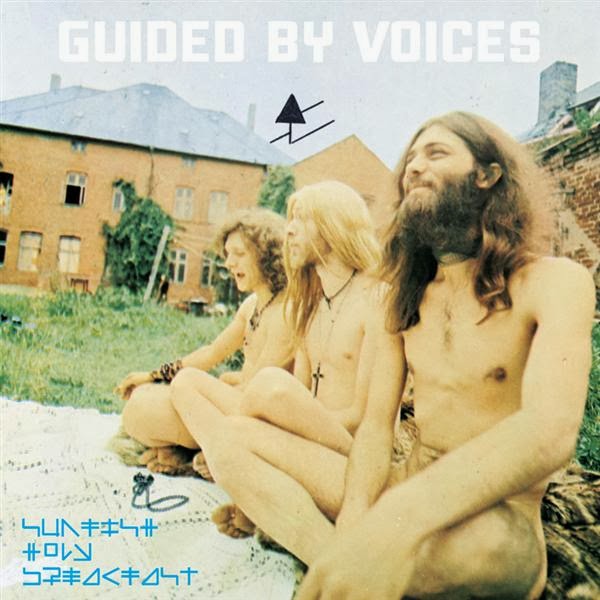
It isn't strange for me to suggest that the title of Guided By Voices Sunfish Holy Breakfast EP was birthed out of a misheard lyric from the song "Sufficiently Breathless" by Captain Beyond.  This kind of notion fits in well with the mythology of the GBV universe.  What is strange is my "proof."  This here is the evidence.

In numerous interviews Robert Pollard has stated that as a youth he based much of his record purchasing decisions based solely on how weird the band names were or how strange the album art was.  Captain Beyond's album Sufficiently Breathless certainly fits the bill.  "Captain Beyond" even sounds distinctly Pollard-esque, like one of the hundreds of band names Pollard dreamt up and made fake album covers for.  This record is definitely in Pollard's Progressive Rock Wheelhouse.

"Nothing Left To Live For..."
I also know that creative inspiration of this type has happened before with GBV.  One of their most widely known albums, Bee Thousand, was partially inspired by a typo on the marquee of a drive-in movie theater seen around town.  This "shout in the street" bled into the proposed "Zoo Thousand" title, becoming Bee Thousand.

Even the artwork on the respective album covers is similar, as both display a band of freaks hanging out in front of buildings with identical red brick walls (more or less).  And the lysergic disposition of the three long hairs sitting in bug-eyed lotus perfectly matches the refrain of the song.
                                                                                               
For me, all the parameters for exquisite bullshit are firmly in place here, bullshit that is just entertaining and coincidental enough to convince a few fans that the story is true.

Who knows?  Maybe it is true.


Here Comes Everybody

I have always been obsessed with artists who command an unexplainable reverence.  Geniuses cloaked in mystery who, despite their fame, really don't belong somehow:  Lenny Bruce, Stanley Kubrick, Andy Kauffman, Aleister Crowley, James Joyce, William Burroughs.

One of the defining characteristics of these artists is that they remain coy when asked "what does it mean?"  Kaufmann never let down his guard.  Kubrick didn't explain shit.  James Joyce dropped Finnegans Wake on the world without a map, and Aleister Crowley reveled in the stupidity of fools.   These artists were content to allow their artistic output to speak for itself.

One thing they all understood is that there is no such thing as an accident.  They undersood that there are certain gestational necessities of the quintessence; that sometimes only silence can transubstantiate the Delphic sparks of the unconscious mind.

Robert Pollard of Guided By Voices is one of these artists.

Enter the rune.

The Rune
Chemical Fun In The Sun

Wrunes For Ever

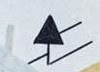
The rune made its first appearance on the Sunfish Holy Breakfast EP, released in November 1996, ten years after the first GBV release, Forever Since Breakfast, also an EP, and also concerning breakfast (a ritual associated with waking up).  Floating like a two-dimensional UFO, this odd little doodle first captured my attention when it reappeared on the cover of Mag Earwhig.   Soon it started showing up on t-shirts and promotional items at tour stops, on the tattooed arms of hardcore fans, and on Isolation Drills, the final appearance of the rune on an official album release (skipping Do The Collapse for some reason).

This "rune" has been referred to as many things: the doodle, the symbol, and most lovingly, the "paper football thingy."  Of all the names given, rune is the most intriguing.  But upon closer examination, something else jumps out.


Compare this writing with the writing of the Lord's Prayer in Old Norse (Runic Alphabet-Futhark):


If we’re labeling anything runic here it should be the alphabet used to inscribe the title, not the "paper football thingy."   

So what the hell is it?


beginners level study of magic must include a discussion of the construction of sigils. Construction of a sigil is an extremely personal creative process which depends on reshaping and condensing multiple elements into a singular form.  It has much in common with collage, putting the use of sigils in Pollard's Magical Wheelhouse.

In modern uses, the concept was mostly popularized by Austin Osman Spare, who published a method by which the words of a statement of intent are reduced into an abstract design; the sigil is then charged with the will of the creator.  Spare's technique, now known as sigilization, has become a core element of chaos magic.  The inherently individualistic nature of chaos magic leads most chaos magicians to prepare and cast (or "charge") sigils in unique ways, as the process of sigilization has not been rigorously defined. Sigils are used for spells as well as for the creation of thoughtforms.

Correctly identifying the letters of the title as runes allowed me to see that the paper football thingy was a sigil constructed out of runes.  

But who's runes?


Finnegans Wake Up With
Skills Like 
This


“To Joyce reality was a paradigm, an illustration of a perhaps unstatable rule.  It is not a perception of order or of love; more humble than any of these, it is a perception of coincidence.”              

Samuel Beckett

I began this exploration with a stoned-comedian riff on the entanglement of Captain Beyond's Sufficiently Breathless and GBV's Sunfish Holy Breakfast (SHB) because it illustrates the kind of lysurgical acrobatics necessary to distill the psycho-metalytic content of James Joyce's alchemical opus Finnegans Wake (I think this process is referred to in the rejected album title Non-Local Leap Frog).  It is this same freak process that I will use to discern the connection between Pollard's sigil and Finnegans Wake.

In Joyce's Finnegans Wake, the character of Humphrey Chimpden Earwicker owns and tends bar in a suburb of Dublin.  His last name Earwicker is considered to be derived from eire-weiker, dweller in Ireland, but also carries many other associations.  One of them is "earwig."

Earwicker, the reader is told, was originally a gardener who spent his days trying to keep earwigs out of his garden.  One day, while he is at work, a king passes by and asks him what he is up to.  Earwicker's response is that he is "cotchin on thon bluggy earwuggers" (31.10-11).  This pleases the king, who then bestows the name 'earwicker' on him (3.27-8).  
Peter Mahon

Earwicker sounds much like "earwigger" and Joyce's dreamer, a Protestant, seems to suspect that his Catholic neighbors maliciously pronounce it that way behind his back.  The earwig is reputed in folklore to cause dreams by crawling into the sleepers ear, so the association Earwicker-earwig is appropriate for a book of dreams.

Robert Anton Wilson

A Waking Universe

From a press release for the album Mag Earwhig (ME):

The first GBV album by their new lineup, which consists of leaders Robert Pollard and Tobin Sprout, backed by the entire lineup of Cobra Verde. This is a conceptual rock opera inspired by the Who's Tommy, the Pretty Things' S.F. Sorrow, Genesis' The Lamb Lies Down on Broadway, and the Edgar Broughton Band's Wasa Wasa. 

Pollard is the main character in this sprawling narrative, an insectile cartoon figure named the Magnificent Earwhig, who interacts with a wild cast of characters in songs evoking nostalgiac memories of an Ohio boyhood, starting one's first band, and inhaling American roadside pop culture. 

"Despite the progressive conceptual 70's mindset informing this project, the record is still a collection of beautifully twisted pop songs and can be listened to as either an opera or just a series of rock arias." 

This could just be a simple coincidence.  But a coincidence involving James Joyce is rarely simple.
Joyce's understanding, use of, and reverence for coincidence has more in common with Jung's definition of synchronicity than coincidence

Synchronicity exposes us to a reality saturated with hyper-dimensional intent.  It is a place where accidents simply do not exist.

Digging deeper into this coincidence of Finnegans Wake and GBV, I realized that both HCE and ME earn their keep by working in bars, establishments dedicated to intoxication, and that both authors, Pollard and Joyce, were born just outside of Dublin:  Joyce a few miles outside of Dublin, Ireland, and Pollard a few miles outside of Dublin, Ohio.  Both spent time as school-teachers, both loved to write, and both loved to sing:

If he had not become a writer, there is a very good chance that James Joyce would still have made a name for himself by pursuing a career as a vocal performer. In 1904 he even shared the stage with the great opera singer and recital artist, John McCormack; and later on in life, after he had established himself as an author, he tirelessly promoted the singing career of his fellow Irishman and tenor, John Sullivan.


Pollard and Joyce both utilize collage as a significant channel for creative expression; Pollard primarily through visual arts, Joyce through the magic ear of the printed word.


Bababadalgharaghtakamminaronnkonnbronntonnerronntuonnthunntrovarrhounawnskawntoohoohoordenenthurnuk!


This was enough entanglement for me to suspect Pollard might also be obsessed with James Joyce.   I say obsession because I don't think anyone is ever casually into Joyce; much like GBV, Joyce is either meh or full-blown obsession.


Visit This Place

Le Soleil Secret


"For a long time I didn’t have my own copy (of Finnegans Wake), because I had given it to Robert Pollard from the band Guided By Voices, of which you may have heard. He plunders it on occasion for song titles and lyrics."

James Greer was a member of GBV from 1994-96, and played bass during the 1995 recording sessions that would become Under the Bushes, Under the Stars.  Leftover material that did not make that album would eventually be released a year later as SHB.  SHB marked the final release of the "classic" GBV era ("One more!").  Pollard would break up the band shortly after and reform with another Ohio group, Cobra Verde, serving as back up band.

SHB then serves as a sort of wake for the GBV funeral, and the proceedings offer a few notable anomalies.  Upon release, Greer became one of only a handful of people in GBV history to have sole songwriting credit with the inclusion of his song "Trendspotter Acrobat." Another sole songwriting credit went to Tobin Sprout's "Jabberstroker" which opens the album.  No other GBV release before or after opens with a song whose sole songwriting credit is someone not Robert Pollard.  And of course there is the first appearance of the sigil.

I suspect that Greer's copy of Finnegans Wake was handed over to Pollard sometime in '95 and from there Joyce's influence began to take effect.  Peeling back a few more layers of the SHB onion we find other clues of Joyce's influence.  Greer's song "Trendspotter Acrobat" is a good name for the kind of deconstructive detective work necessary to make sense of Finnegans Wake, and Sprout's "Jabberstroker" is evocative of "Jabberwocky," the nonsense poem written by Lewis Carrol, and a major influence on Joyce:

Many of the words in the poem are playful nonce words of Carroll's own invention, without intended explicit meaning. 

When Alice has finished reading the poem she gives her impressions:
'It seems very pretty,' she said when she had finished it, 'but it's rather hard to understand!' (You see she didn't like to confess, even to herself, that she couldn't make it out at all.) 'Somehow it seems to fill my head with ideas—only I don't exactly know what they are! However, somebody killed something: that's clear, at any rate.'

This may reflect Carroll's intention for his readership; the poem is, after all, part of a dream. In later writings he discussed some of his lexicon, commenting that he did not know the specific meanings or sources of some of the words; the linguistic ambiguity and uncertainty throughout both the book and the poem may largely be the point. 

Pollard's lyrical wordplay has also been accused of "linguistic ambiguity and uncertainty," but these accusations only hold weight through a superficial listen.  Any substantial investment of time reveals that even the oddest turn of phrase manifests some meaning (objective, subjective or otherwise).


 Factory Of Raw Essentials


"I thought about it, a few years actually, and I decided that meaning and language are two different things. And that what the alien voice in the psychedelic experience wants to reveal is the syntactical nature of reality. That the real secret of magic is that the world is made of words, and that if you know the words that the world is made of you can make of it whatever you wish."

Terence McKenna


Taking over 17 years to construct, the Wake is the result of throwing multiple languages and systems of thought from countless cultures throughout history into an alchemical pot.  Joyce's decisions here were guided by voices from the past, the present, and even, as some have boldly suggested, the future.

If you have never skimmed the contents of the Wake, it is an unnerving confrontation with the bizarre, and impenetrable for the novice.  One cannot simply dive in head first; one must start slowly, almost as if one were a child learning how to read  (Pollard being no exception).  Knowing the competitiveness that drives a man like Pollard, being confronted with the language of Finnegans Wake (FW) must have lit a fire to discover all of it's secrets.

The best way to start is to cheat.  Find someone to hold your hand and take you into the mess (see Joseph Campbell's Skeleton Key to Finnegans Wake).   With plenty of miles to cover on the road from gig to gig during those years, I imagine Pollard spent some time with a few of the many guidebooks that help usher the novice into the Wake.

Personally, I was lucky enough to discover a book called Coincidance by Robert Anton Wilson.  After dozens of readings of Wilson's exegetical work on FW, I slowly started to grasp what Joyce was attempting with the construction of the Wake.  Many years later, when I fully realized what Joyce had accomplished, I awoke from what felt like a very, very long sleep; it had truly been forever since breakfast.

I get the sense that Pollard experienced much of the same thing.


Get Under It

According to Robert Anton Wilson,  Joyce's notes for FW reveal a runic architecture that Joyce used to build FW.  This architecture forms a family tree which drives the dynamics of FW, which ultimately reveal the inevitable recursive fall of man.  This family tree reflects not only the dynamics of the I Ching and the binary system of Leibniz, but also the dynamics of DNA and quantum physics as well.  It illustrates the intersection of spirit and matter, and is the way reality seems to be when it is stripped down to it's most naked state.


At the top of this family tree is The Tao.  The Tao is a poetic representation of non-locality, that which remains when the dimensions of space and time leave the building.  According to Joyce, when the Tao is expressed locally (in the space/time continuum) it manifests as the mutually exclusive entanglement known as Yin and Yang (Female and Male, Wave and Particle).

Yang = Male = Particle

A particle can be either positive or negative, just as Yang can be either active or passive.  These polarities are further refined into the neutral particle, the moving Yang, also expressed as the mutational aspect of DNA into RNA.

Robert Anton Wilson believes Joyce expressed his understanding of this unified polar dynamic as "space-oriented arts like painting in opposition to time-oriented arts like music, with the eventual synthesis of both into Joyce space-time prose being gently hinted at."

The symbol for this synthesis of space-oriented arts and time-oriented arts is:


Though not exact, it certainly looks a lot like a goal post, or a busted tuning fork.


If Pollard's study of Joyce had led him far enough down the rabbit hole to find this symbol, it's meaning would have been heard loud and clear.  This polar dynamic not only merges athletics (goalpost) and music (tuning fork), it also reflects the synthesis of an artistic duality, with collage as our space-oriented art, and rock and roll our time-oriented art.

As a sigil intends, this rune is gently reoriented as a reflection of the magician's personalized influence.


Catching Waves Again

The second component of the sigil is the triangle sailing through the uprights.  This triangle in Joyce's runic alphabet represents the divine feminine, the Yin, the negative coil of DNA, or the Wave aspect of matter.  It could also be considered a muse.

Yin = Female = Wave

In Pollard's sigil, the triangle is colored in, reflecting the magicians personalized influence.


Into the Void and Over the Goal Post

Why would Pollard choose to mutate and merge these particular runes into a sigil?    What could his intentions have been in 1996, with GBV on pause, and Pollard three years away from breaking through to the "big leagues" of major label rock and roll?


Here I go around the blame 
Here I go with hand over flame 
Down on the floor at 9:00 
A scene not fully recognized 
At precisely 9:00 
Here I go with clapping hands 
Here I go with "still no plans" 
Illuminate the mystery 
The film is not for view 
The film is not for you.

Bomb In The Beehive - R. Pollard